
Banks Just Too Big To Fail? Iceland Proves Otherwise; After Punishing Creditors, Economy Returns To Strong Growth
Banks just too big to fail? Iceland shows otherwise
Decision to let banks go under looks smarter by the day, in contrast to Ireland's costly bailout.
On his second day as head of Iceland's third-largest bank, Arni Tomasson faced a crisis: the firm that regulators had asked him to run was out of cash.
It was October 8, 2008, at the height of the global financial meltdown and Iceland's bank assets in Britain had been frozen. Customers flocked to branches of Tomasson's Glitnir Banki to withdraw money, even though the Government had guaranteed their deposits. By the end of the day, the vaults were empty, says Tomasson, recalling the drama.
The only way Glitnir and other lenders could avoid a panic the next morning was to get more cash, which they were having trouble doing. A container of crisp kronur sat on the tarmac at Reykjavik's airport awaiting payment.
The British company that printed the bills, De La Rue, was demanding sterling, and the central bank couldn't access its British account.
"Everybody was panicked - depositors, creditors, banks around the world," Tomasson says.
But Tomasson got the cash he needed that night after the central bank managed to open an emergency line of credit with a European lender. Now he's sitting in an office in Reykjavik, handling about US$24 billion ($32 billion) of claims by creditors as life in Iceland's capital returns to normal.
Unlike other nations, including the US and Ireland, which injected billions of dollars of capital into their financial institutions to keep them afloat, Iceland placed its biggest lenders in receivership. It chose not to protect creditors of the country's banks, whose assets had ballooned to US$209 billion, 11 times gross domestic product.
The crisis almost sank the country. The krona lost 58 per cent of its value by the end of November 2008, inflation reached 19 per cent in January 2009, GDP fell 7 per cent that year and the Prime Minister resigned after nationwide protests.
But with the economy projected to grow 3 per cent this year, Iceland's decision to let the banks fail is looking smart.
- "Iceland did the right thing by making sure its payment systems continued to function while creditors, not the taxpayers, shouldered the losses of banks," says Nobel laureate Joseph Stiglitz, an economics professor at Columbia University in New York. "Ireland's done all the wrong things, on the other hand. That's probably the worst model."
Ireland guaranteed all the liabilities of its banks when they ran into trouble and has been injecting capital - €46 billion so far - to prop them up. That brought the country to the brink of ruin, forcing it to accept a rescue package from the European Union in December.
---
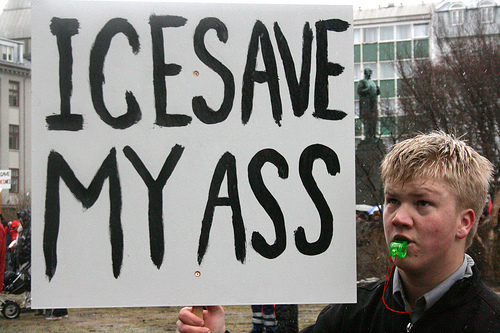
Icesave protest - Oct. 4, 2010
---
 Feb 25, 2011 at 2:08 AM
Reader Comments (9)
Decision to let banks go under looks smarter by the day, in contrast to Ireland's costly bailout
On his second day as head of Iceland's third-largest bank, Arni Tomasson faced a crisis: the firm that regulators had asked him to run was out of cash.
It was October 8, 2008, at the height of the global financial meltdown and Iceland's bank assets in Britain had been frozen. Customers flocked to branches of Tomasson's Glitnir Banki to withdraw money, even though the Government had guaranteed their deposits. By the end of the day, the vaults were empty, says Tomasson, recalling the drama.
The only way Glitnir and other lenders could avoid a panic the next morning was to get more cash, which they were having trouble doing. A container of crisp kronur sat on the tarmac at Reykjavik's airport awaiting payment.
The British company that printed the bills, De La Rue, was demanding sterling, and the central bank couldn't access its British account.
"Everybody was panicked - depositors, creditors, banks around the world," Tomasson says.
But Tomasson got the cash he needed that night after the central bank managed to open an emergency line of credit with a European lender. Now he's sitting in an office in Reykjavik, handling about US$24 billion ($32 billion) of claims by creditors as life in Iceland's capital returns to normal.
Unlike other nations, including the US and Ireland, which injected billions of dollars of capital into their financial institutions to keep them afloat, Iceland placed its biggest lenders in receivership. It chose not to protect creditors of the country's banks, whose assets had ballooned to US$209 billion, 11 times gross domestic product.
The crisis almost sank the country. The krona lost 58 per cent of its value by the end of November 2008, inflation reached 19 per cent in January 2009, GDP fell 7 per cent that year and the Prime Minister resigned after nationwide protests.
But with the economy projected to grow 3 per cent this year, Iceland's decision to let the banks fail is looking smart.
"Iceland did the right thing by making sure its payment systems continued to function while creditors, not the taxpayers, shouldered the losses of banks," says Nobel laureate Joseph Stiglitz, an economics professor at Columbia University in New York. "Ireland's done all the wrong things, on the other hand. That's probably the worst model."
Ireland guaranteed all the liabilities of its banks when they ran into trouble and has been injecting capital - €46 billion so far - to prop them up. That brought the country to the brink of ruin, forcing it to accept a rescue package from the European Union in December.
Iceland bank crash execs charged
http://www.icenews.is/index.php/2012/02/22/iceland-bank-crash-execs-charged/
[snip]
Iceland’s special prosecutor into the banking crash is pressing charges against four former top executives at the now-defunct Kaupþing Bank. The charges relate to market manipulation in co-operation with a Qatari sheikh in the autumn of 2008.
It has today been revealed that charges were last Friday laid against Sigurður Einarsson, the bank’s former chairman; Hreiðar Már Sigurðsson, former president; Magnús Guðmundsson, former boss of Kaupþing Luxembourg; and Ólafur Ólafsson from the Samskip transport company, who was a board member and major owner at Kaupþing.
The alleged breach of the law concerns Qatari Sheikh Mohammed Bin Khalifa Al-Thani’s purchase of around five percent of the entire bank shortly before its collapse.
http://www.icenews.is/index.php/2012/05/09/majority-of-icelanders-against-joining-eu/
I can hardly wait to see Cheyenne's movie. hope it gets to Colorado soon.
Even though with rules wrongdoing is rampant to the point that no one even cares anymore, it is just expected, and rewarded...
If people really and truly wanted regulation to go away they would first stop commiting the crimes of avarice and convenience that they continue to get busted doing as a sign of good faith, but they can't even do that. That tends to lead one to believe it is not really the crime they want to go away, just the laws that hold them liable. Hence crime becomes "good business".
http://youtu.be/51-Jfh6ADH0
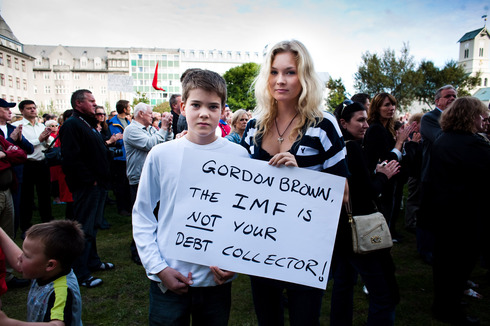
http://www.icenews.is/2013/01/24/icelands-president-vilifies-former-british-pm-gordon-brown-over-icesave-crisis/